KAST w CS2 i na FACEIT - co to jest i jak to liczyć?
KAST - what it actually is
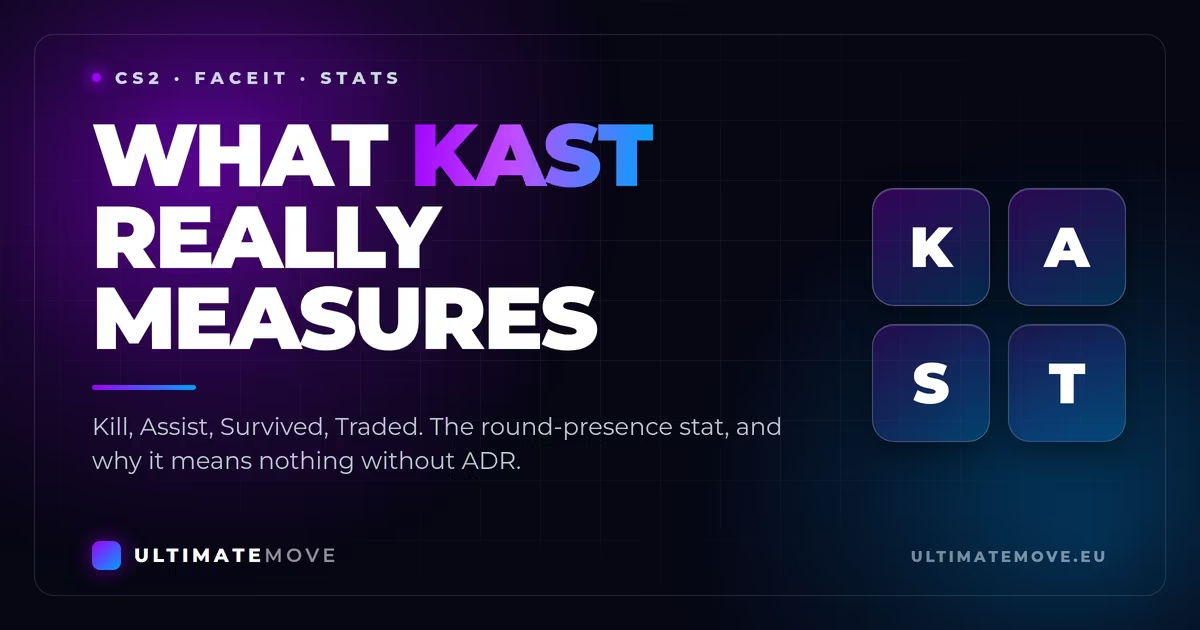
KAST is the percentage of rounds in which you did at least one of four things: a Kill, an Assist, Survived the round, or got Traded - meaning a situation where you died but a teammate instantly killed the player who killed you. One round, four ways to count.
And that is the whole point of this stat. KAST does not ask how many frags you racked up. It asks how many rounds you were actually present in.
| Letter | What it means | When it counts |
|---|---|---|
| K - Kill | Kill | You killed someone in that round |
| A - Assist | Assist | You dealt damage or landed a flash before a teammate got the kill |
| S - Survived | Survival | You made it to the end of the round |
| T - Traded | Trade | You died, but a teammate killed your killer right after |
One of those four is enough. A round where you died on entry, nobody traded you and you had not dealt damage beforehand - that is the only scenario where the round goes in the bin.
Why it beats K/D
K/D lies. A player with 25 frags in a match, where 14 of them came in three rounds and in the other eighteen he was on the floor after ten seconds, has a great K/D and a lost match.
KAST will not forgive that. What counts there is consistency, not spikes. You cannot farm it with one good round or one clutch. You simply have to be useful in most rounds.
That is why FACEIT, HLTV and analytics tools show it next to ADR and Rating. Each of those three numbers answers a different question:
- KAST - in how many rounds did you contribute anything?
- ADR - how much damage do you deal per round on average?
- Rating - how does your total contribution compare against the reference base?
BIOS, memory, network and input we go through together on your screen. We measure before and after in your games, so you see the difference yourself, before we hang up.
What counts as a good KAST?
The range most players fall into is roughly 60-80%. Below 60% is a signal that something is badly wrong. Above 80% is rare and usually means either a very good player or a very passive one - more on that in a moment.
| KAST | What it usually means |
|---|---|
| Below 60% | You die in rounds where you contributed nothing. A positioning problem, or bad timing on entries. |
| 65-70% | Decent. The typical level of a player who knows the map and does not do anything stupid. |
| 70-75% | Solid. You do something in most rounds. |
| Above 75% | Very good - if it goes hand in hand with ADR. If not, see below. |
One important caveat: these thresholds are a reference point, not a law of physics. Your role matters. An entry fragger who goes in first will always have a lower KAST than an AWPer sitting at the back - and that does not mean he plays worse.
The trap: high KAST with low ADR
This is the most common mistake in reading this stat, and I see it regularly when I go through demos in coaching sessions.
You can put up 78% KAST and still be dead weight for the team. All it takes is playing to survive. Sit in a corner, avoid duels, make it to the end of the round. The letter S counts without killing anyone.
That is why you always read KAST together with ADR. Three combinations you will see most often:
- High KAST, high ADR - you are in the round and you do something in it. That is what a player who actually carries a match looks like.
- High KAST, low ADR - you survive but you do not fight. The letter S does all the work while the team plays five on four.
- Low KAST, high ADR - you deal damage, just in too few rounds. Usually a timing problem: you go in alone or too early.
The most common mistakes that eat your KAST
- You go in alone. With no teammate behind you there is nobody to trade you. The letter T is gone, and the round with it.
- You deal no damage before dying. One shot into someone a teammate finishes off is an assist. Zero shots is zero.
- You do not throw flashes. A flash assist counts the same as a damage assist, and it costs 200 dollars and one second.
- You hold a position you cannot leave. If you die where nobody can see you and nobody can trade you - that is the worst possible scenario.
- You play for survival instead of for the round. The opposite problem. KAST goes up, the team loses, and nobody thanks you.
How to actually raise it
You cannot train KAST directly, because it is an output stat. It rises when you fix specific things:
- Get into trade range. A few metres behind your teammate, in the same corner, with a line on the same choke. The letter T comes from distance, not from good intentions.
- Shoot before you die. Even 20 damage into someone a teammate finishes off saves the round in the stats.
- Throw flashes for someone. The cheapest way to an assist, and the only one that works even in eco rounds.
- Drop positions with no way out. If you cannot back out of a given corner, you lose the whole round on first contact.
- Watch ten rounds where KAST was lost. Not the whole match. Those rounds alone show the pattern in a few minutes - usually the same mistake on the same map.
Five things to remember
- KAST is presence, not firepower. It measures how many rounds you contributed anything in.
- One of the four letters is enough. Kill, assist, survival or trade.
- 60-80% is the normal range. Below 60%, look for the problem in your positioning.
- Never read it without ADR. KAST alone can be farmed with passive play.
- Role matters. An entry fragger and an AWPer are not playing for the same number.
FAQ
What does KAST stand for?
KAST stands for Kill, Assist, Survived, Traded. It shows the percentage of rounds in which a player got at least one of those four things.
What is a good KAST on FACEIT?
Most players fall in the range of 60-80%. Around 70% is a solid result, above 75% very good - provided it goes hand in hand with decent ADR.
Does a high KAST mean I play well?
Not necessarily. You can push it up just by surviving rounds, with no kills and no damage. Always put it next to ADR and next to whether the team is winning.
How is KAST different from K/D?
K/D counts kills and deaths. KAST counts rounds in which you were useful. You can have a great K/D and a weak KAST if the frags come in a handful of rounds and you die without contributing in the rest.
What is a trade in KAST?
A trade is a situation where you died but a teammate killed your killer right after. The round still counts towards your KAST.
Does KAST work the same in CS2 and on FACEIT?
The definition of the four components is the same. Details, for example the trade time window, can differ between platforms and analytics tools, so compare results within one system.
Related articles
- FACEIT CS2 ranks - levels, ELO thresholds and table (2026)
- How to rank up on FACEIT CS2: the complete 2026 guide
- UDA - free CS2 demo analyser
- 10 best ways to improve your CS2 gameplay
Frames dropping exactly when the fight starts?
Deadlock leans hard on the CPU during team fights, which is the moment your frames fall and your aim stops landing. We tune your PC remotely: Windows, drivers, BIOS and network. You can measure it yourself before and after, in the game, with us watching. We do not stop you.
See PC optimizationSatisfaction guarantee and six months of support after the session. Not sure if it is worth it? Ask for a free check on our Discord.Our free tools
Built in house. No account, no limits.
 Ultimate Demo Analyzer
Upload a CS2 demo and get your mistakes and round stats written out.
Free, no account Deadlock Replay Analyzer
The same for Deadlock: a replay breakdown and a plan for the next matches.
Free, no account Sensitivity Converter
Carry your cm/360 between games without losing muscle memory.
Free, no account Aim Trainer
Thirty seconds, three levels. No install, no account.
Free, no account