The Silent Decline of Skill in Modern Gaming: Based on UltimateMove Coaching reports.
Why Gamers Are Getting Worse Despite Better Hardware - And What This Means for the Future of Gaming
TLDR:
Your rank does not increase due to the “Dopamine Loop,” but rather due to weak equipment.
Our data shows that 70% of players do not remember their mistakes after a game.
Solution: You need to change the way you train, not just play more. Read on to find out how.
The gaming industry has reached its technological peak. Players haven’t.
Over the last decade, gaming hardware has exploded in quality. 240+Hz monitors, OLED panels, ultra-precise mice, aim trainers, AI-powered analytics - everything suggests that players should be the strongest they’ve ever been.
Yet data from coaching sessions, esports teams, ranked ladders and performance analysis paints a very different picture:
👉 Overall player performance has stagnated. In some areas, it has actually declined.
Not just aim in the most part, (Luckily there are aimer movements). (Also you can get Aimlabs+ first month 50% off with: UltimateMove50)
communication
- game sense,
- teamwork,
- communication,
- dyscipline,
- consistency,
- and long-term skill development.
How is this possible?
To understand the decline, we need to look at four major trends shaping modern gaming.
1. The Instant Gratification Loop Has Replaced the Learning Process
Psychologists call this the dopamine dominance loop:
➡️ hit play, ➡️ get a hit of reward, ➡️ queue again, ➡️ but you don’t reflect, analyze or adjust.
After analyzing over 30 initial sessions in UltimateMove, we found that over 70% of players could not recall a single specific mistake they made during their last game.
They remember the outcome, not the process.
This is the core issue.
A generation of players is conditioned to expect progress without the work that historically created it:
- reviewing demos,
- understanding map geometry,
- learning timing,
- communicating intention,
- reflecting on mistakes.
Modern gaming has shifted from mastery → to fast food.
*Every mention is a part of our Coaching Services
BIOS, memory, network and input we go through together on your screen. We measure before and after in your games, so you see the difference yourself, before we hang up.
The Tools Are Better Than Ever - But Misused
Aim trainers, VOD review tools, analytics dashboards - all amazing resources.
But here’s the surprising insight:
Players often mistake “tool usage” for “actual training.”
Grinding 40 minutes of aim trainer routines builds mechanics. But it does not build:
- decision-making,
- positioning,
- timing,
- information processing,
- adaptive thinking,
- composure under pressure.
Across the players we analyzed, the strongest predictor of improvement was not aim precision but decision efficiency: how fast a player interprets, decides, and acts.
And yet almost no young player trains that.
They double down on mechanics, because mechanics feel rewarding.
Thinking doesn’t.
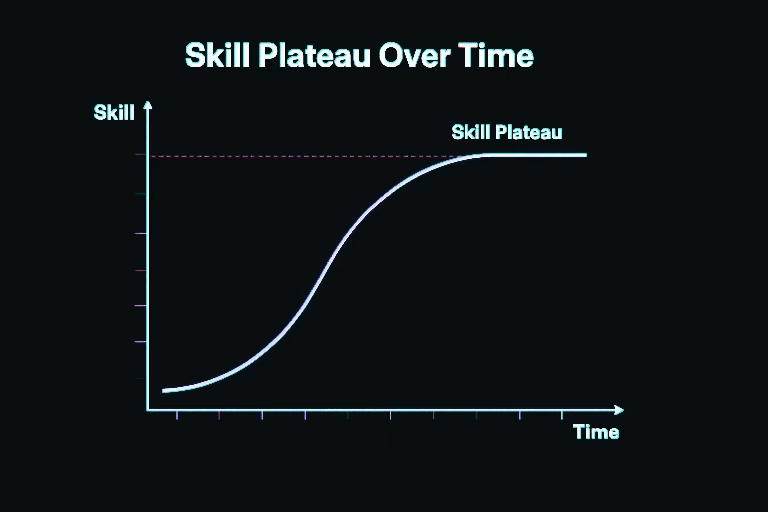
This creates an illusion of progress - fast improvement early, then a complete plateau.
3. Games Became Faster Than Players Could Adapt
Developers increased content output dramatically:
- shorter seasons,
- more agents/heroes,
- constant meta shifts,
- more abilities,
- higher mechanical ceilings,
- reduced downtime,
- new systems every few weeks.
This keeps the games exciting.
But there’s a side effect:
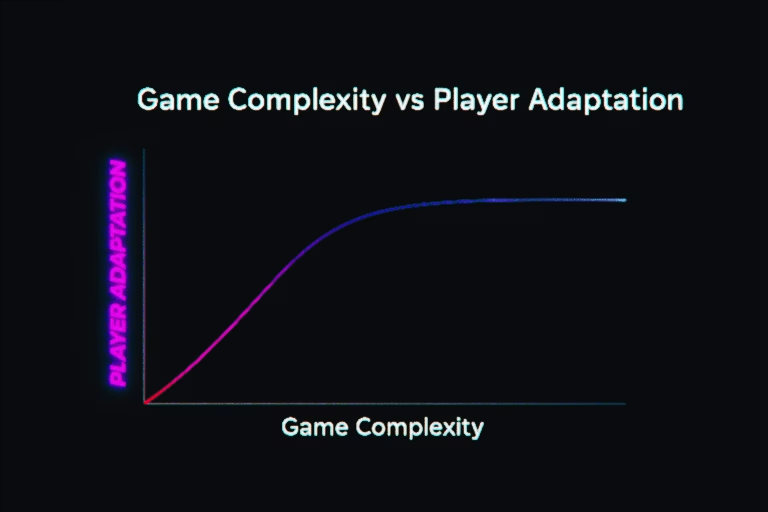
The game evolves every month. The player evolves every year.
The gap widens.
In the past, players had years to master a meta. Today, they barely have weeks.
Long-term skill acquisition has no chance to stabilize.
Players get overwhelmed → impatient → frustrated.
Game complexity is rising faster than human cognitive adaptation.
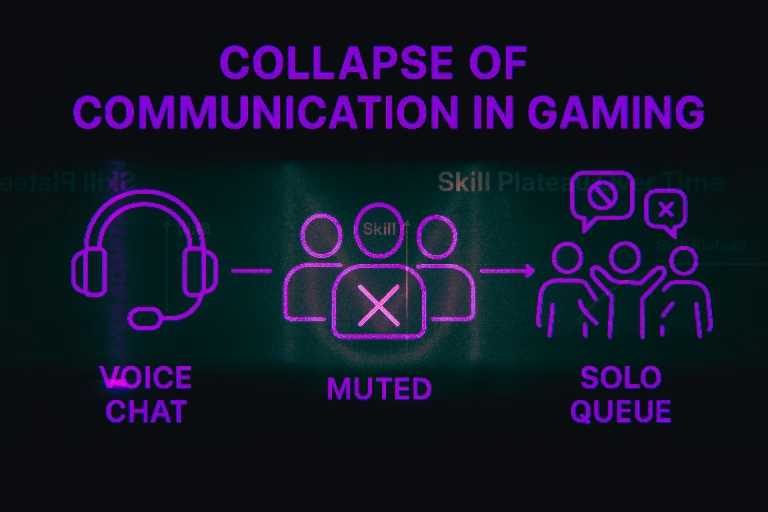
4. The Collapse of Community Learning
A decade+ ago, learning was social:
- team scrims,
- forum discussions,
- clan systems,
- VoIP communication,
- mentorship,
- collaborative replay review.
Today, 80% of solo queue players (unless they want to flame XD) don’t use voice chat at all.
Players don’t learn with the game - they survive next to it.
This removes the #1 accelerant of skill development:
interactive feedback
You can’t grow team-based skills in isolation:
- trading roles,
- setting crossfires,
- macro strategy,
- adaptation to teammates,
- coordinated timing,
- tempo control.
Solo queue rewards individual comfort over collective mastery.
We are producing strong solo mechanics - but weak team players.
And e-sports is a team ecosystem.
Why This Matters for the Future of Gaming
If the gap between game complexity and player development continues to grow, several outcomes are likely:
- more frustration → lower retention,
- more toxicity → worse environments,
- fewer high-skill players → shallower competitive scenes,
- e-sports pipelines thinning,
- devs forced to simplify games,
- mid-level players stuck in permanent plateaus.
This isn’t a hardware issue. It’s a human development issue.
And like every human development issue - it requires structure.
So How Do We Fix It? (A Practical Framework)
Below is the exact structure we use at UltimateMove, the same one that consistently unlocks breakthroughs for players.
1. Replace randomness with deliberate routines
At least 10 minutes of focused analysis > 2 hours of random grinding.
2. Teach decision-making before mechanics
A moderately accurate player with excellent decisions outperforms a cracked aimer with no structure.
3. Build micro-habits
Small, repeatable, predictable actions beat hype-based motivation.
4. Train emotional control
Players who can stay calm under pressure improve 4-5× faster.
5. Reintroduce real coaching
Not hype. Not ego boosts. Not “play more and you’ll improve.”
But structured, measurable skill development:
- review systems,
- strategic frameworks,
- clarity of intention,
- feedback loops,
- mental resilience.
Gaming is maturing.
And coaching is becoming not an advantage - but a requirement.
The Mission Behind UltimateMove
I built UltimateMove to solve exactly this problem:
To return players to the fundamentals that once defined greatness:
- passion,
- process,
- discipline,
- community,
- and the love of mastery.
Not to sell illusion. Not to inflate ego. But to restore real skill acquisition in a world dominated by shortcuts.
If you’ve noticed the decline in player quality - you’re not imagining it.
It’s happening.
And the only way to reverse it is to talk about it openly, understand it deeply, and rebuild the mental framework behind player development.
What I’d love to hear from you:
Do you think the average player today is stronger or weaker than years ago and why?
Thank you for reading and I Hope you had a great time! 😀
 KaRzye
Runs the research and every session at UltimateMove. FACEIT Level 10 in CS2,
Immortal in Valorant. Twenty years in BIOS, memory and drivers.
Watch him play.
KaRzye
Runs the research and every session at UltimateMove. FACEIT Level 10 in CS2,
Immortal in Valorant. Twenty years in BIOS, memory and drivers.
Watch him play.
Our free tools
Built in house. No account, no limits.
 Ultimate Demo Analyzer
Upload a CS2 demo and get your mistakes and round stats written out.
Free, no account Deadlock Replay Analyzer
The same for Deadlock: a replay breakdown and a plan for the next matches.
Free, no account Sensitivity Converter
Carry your cm/360 between games without losing muscle memory.
Free, no account Aim Trainer
Thirty seconds, three levels. No install, no account.
Free, no account