Jak Przestać tiltować w CS2 - Artykuł i Porady od FACEIT LVL 10
Every guide about tilting in CS2 looks the same. "Take a deep breath. Take a break. Mute toxic players. Think positive." You know this. I know this. And you know what? You're still tilting.
Because those tips fix the symptom, not the cause. Tilt isn't an emotional problem you'll solve with breathing exercises. It's a structural problem - and to fix it, you need to understand what's actually driving it.
This article is different. No clichés. A concrete breakdown of where tilt comes from, what's really happening in your head when you're raging after a lost round, and what actually works - because coaching dozens of players at every skill level gives you a very clear picture of where the problem actually lives.
What Tilt Actually Is?
Tilt comes from poker. It describes a state where emotions take control of your decisions - and you start playing differently than you do when you're calm. Everyone shows it differently, but as a rule, it's not that your mechanics get worse. Your decision-making does.
That's an important distinction. When you're tilted, you don't suddenly lose your aim (unless you lose control to the point where the nerves travel into your hands). You lose the ability to make the same decisions you make when you're playing well. You start:
- Peeking angles you'd normally avoid
- Pushing solo because "I have to do something"
- Buying without looking at the team economy
- Playing for your ego instead of for the round win
- Looking for someone to blame instead of solutions
Tilt isn't anger. It's losing the algorithm of your game. And that's exactly why it's so dangerous - you don't feel like you're playing badly. You feel like you're doing the right things and just getting unlucky. That's not true.
Where Tilt Really Comes From - 4 Real Sources
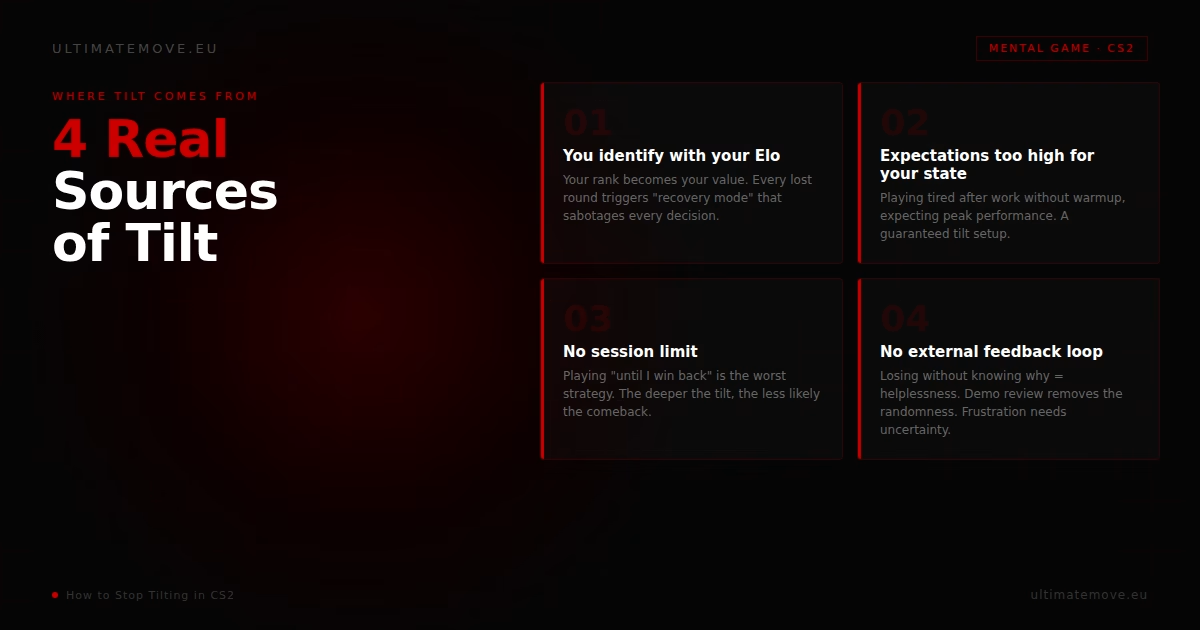
1. You identify with your Elo instead of your process
This is by far the most common reason. Your rank is you. Your Elo is your value. When you lose rounds, you lose something of yourself.
That sounds dramatic, but that's exactly how it works psychologically. When Elo drops, your brain registers it as a real loss - the same as losing money or reputation. And it activates a "recovery mode" that completely sabotages your play.
What it looks like in game: You stop playing to win the round and start playing to recover Elo. Those are completely different goals and they lead to completely different decisions.
What changes it: Elo is a consequence of playing well - not a goal in itself. The players who get out of tilt fastest are the ones who can genuinely say "this lost round is a sample of my decisions, not a verdict on my worth." That's not a cliché. It's a specific shift in perspective that you can train.
2. Your expectations are systematically too high for your current state
Most players tilt when they play below their expectations. The problem is that those expectations are often inflated.
If you're playing for 3 hours after a full day of work, tired, without a proper warmup - and you expect to perform at your peak - you're a guaranteed tilt candidate. Because you'll be playing below your own standards and you won't understand why.
What it looks like in game: "I can't remember the last time I played this badly. Something's off today. The game is broken. The servers are lagging."
What changes it: One second of honest self-assessment before each session. Am I rested? Warmed up? In a good place mentally? That's not weakness - that's calibration. Pro teams hire performance coaches specifically to manage this. s1mple has spoken openly about stepping away from the game after frustrating matches instead of queuing again. As we've mentioned in previous articles - donk said his preparation is literally just playing - he simply knows he has the skills.
3. No session limit and no exit strategy
One of the simplest and most commonly ignored factors. Players who tilt into 8-match losing streaks do it because they never decided when to stop.
You have no rule. No limit. You play "until you win" - which is exactly the worst strategy you can have, because the deeper you are in tilt, the less likely you are to win, the more you want to "recover", the deeper into tilt you go.
What changes it: One rule, decided before every session. Two losses in a row - done for today, review the demo tomorrow. Doesn't matter that "you're close to recovering." Doesn't matter that "it's just one more game." This rule only works if it's absolute, because every exception is training yourself to ignore the rule.
Elite teams do the same. High-ranked players often stop after 3 games - regardless of result - because they know emotional bandwidth has a limit.
4. You have no external feedback
This is the most subtle reason, but it has the biggest long-term impact.
Tilt grows when you feel like you have no control over your progress. When you're losing and you don't know why - when you have no information about where the loss came from - your brain interprets that as a loss of control. Loss of control = frustration = tilt.
Players who do regular demo review tilt less often - not because they have a "better mindset", but because after every session they know something specific about what went wrong. Frustration requires uncertainty. When you have a concrete answer ("I'm dying 7 times from the same angle on Mirage long because my crosshair placement is too low"), frustration has an outlet. It becomes a problem to solve instead of a feeling of helplessness.
BIOS, memory, network and input we go through together on your screen. We measure before and after in your games, so you see the difference yourself, before we hang up.
What Actually Works - Concrete Tools
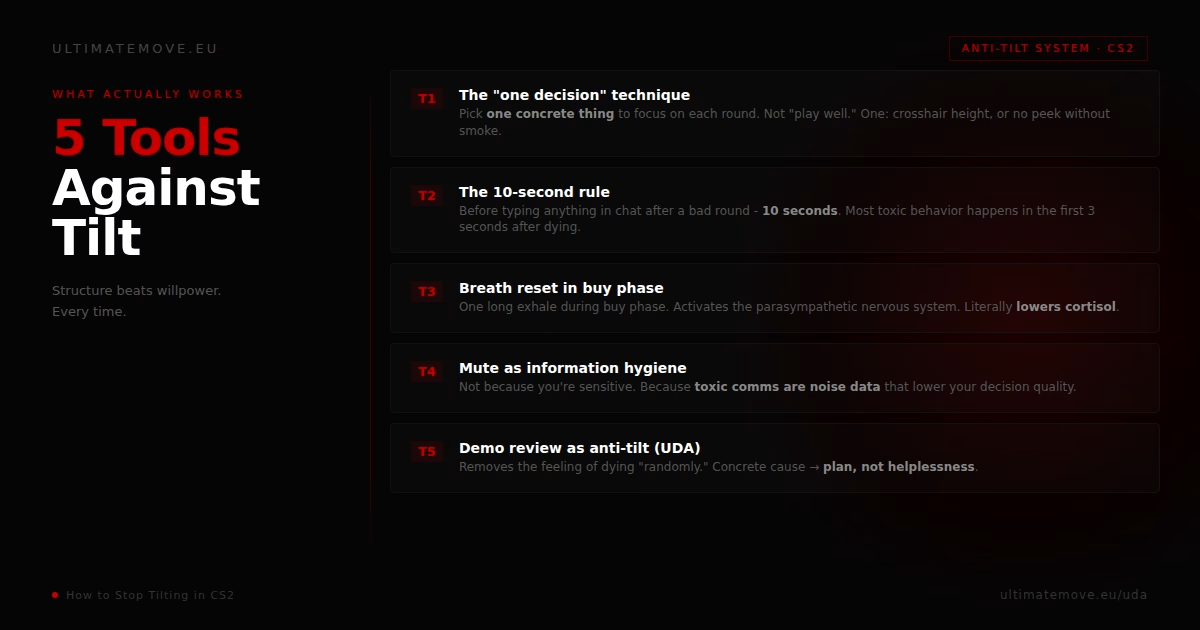
Tool 1: The "one decision" technique
Before each round, pick one specific thing to focus on. Not "play well." One thing: "I keep my crosshair at head height all round" or "I don't peek until I have a smoke."
This moves your attention from the outcome to the process. And gives you something to evaluate that doesn't depend on whether you won the round or not.
Tool 2: The 10-second rule
Before you type anything in chat after a bad round - 10 seconds. That sounds trivial. It isn't. The vast majority of flaming and toxic behavior that feeds the tilt spiral happens in the first 3 seconds after dying.
It's not about always writing nice things. It's about having a moment to decide whether what you want to type helps you win this game. It almost never does.
Tool 3: The breath reset between rounds
The buy phase gives you 15-20 seconds. One deep inhale and a slow exhale during that time - not through the entire buy phase, literally one long exhale - is enough to partially reset your nervous system after a bad round. Sounds like pseudoscience, but it has solid physiological backing - a slow exhale activates the parasympathetic nervous system and lowers cortisol.
You don't have to meditate. One exhale, you lunatic XD.
Tool 4: Muting as information hygiene, not emotional weakness
Most players consider muting someone a last resort - after that person has already frustrated them. That's too late.
Reframe it: you're muting someone not because you're sensitive, but because toxic communication is noise data that clutters your model of the game, interferes with thinking, and with rationally analysing what just happened. The information you get from a tilted player lowers the quality of your decisions. That's a rational call, not an emotional one.
Tool 5: Demo review as anti-tilt, not just improvement
UDA - our free demo analyzer - isn't just a improvement tool. You could also call it an anti-tilt tool.
Why? Because one of the strongest tilt triggers is the feeling that you're dying "randomly" or "unfairly." When you open a demo and see exactly what happened - where your crosshair was, what the opponent knew, what decision you made - the randomness disappears. What's left is a concrete cause. And a concrete cause is something you can fix. And something you can fix doesn't trigger frustration - it triggers a plan and reflection.
Spend 10 minutes in UDA after every session where you tilted. The heatmap will tell you where you were dying. The Gameplay Analysis tab will surface your mistakes and strengths. Find the pattern. Leave each session with one concrete takeaway.
What Tilt Looks Like at Different FACEIT Levels
Level 1-5: Tilt usually comes from feeling "out-aimed" or "cheated against." In reality, you're losing duels because crosshair placement and counter-strafing are inconsistent. Focusing on one of those things instead of the result radically reduces frustration.
Level 5-8: Tilt usually comes from feeling like you have "bad teammates." In reality, teams at this level are roughly equal - you're tilting because your own mid-round decisions are unstable under pressure and you're looking for external blame. Demo review reveals this very quickly.
Level 8-10+: Tilt comes from the pressure of expectations - from yourself and potentially from others. This is the level where mental work becomes just as important as mechanics. A tilted Level 9 player is someone who knows what they should be doing and doesn't do it under pressure. That's a coaching problem - you can't fix it alone because you're simultaneously the player and the observer, and those two perspectives cancel each other out.
When Tilt Is a Signal to Stop
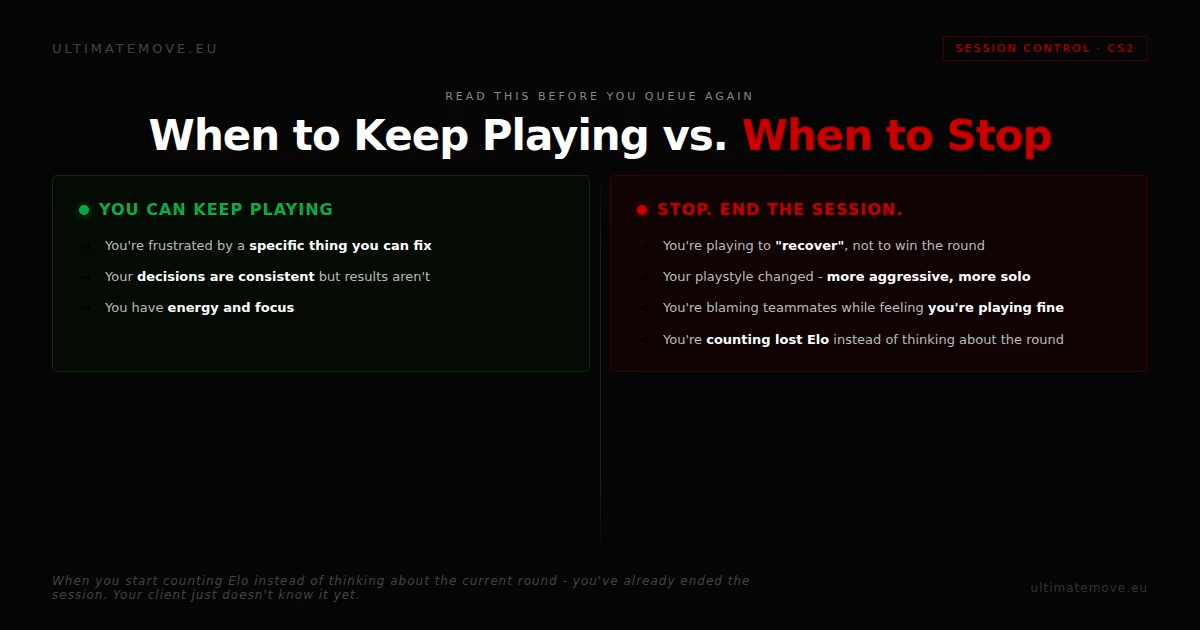
There's a difference between ordinary frustration and the symptoms that tell you to end the session.
Signs you can keep playing:
- You're frustrated by a specific thing you can fix
- Your decisions are consistent but the results aren't
- You have energy and focus
Signs you should stop:
- You're playing to "recover" not to win the round
- Your playstyle has changed - more aggressive, more solo, more peeking
- You're blaming everything on teammates and feel like you're playing fine yourself (sometimes you might be right XD)
- You're carrying a trigger from the previous session into the new one
The most important signal: when you start counting the Elo you've lost instead of thinking about the current round - you've already ended the session, your client just doesn't know it yet.
Summary: What You Need to Change to Stop Tilting
Tilt is solved with structure, not willpower.
One session rule (stop after two losses in a row). One decision before each round. One exhale in the buy phase after a bad round. Muting as hygiene not weakness. Demo review after every session with one concrete takeaway.
These aren't tips from a life coach. This is a system that's worked for players at every level - because it's based on the actual cause of tilt, not the symptoms.
If you've been working on this for a while and you keep falling into the same patterns - blind spots are by definition invisible from the inside. That's exactly what coaching is for. Outside eyes see what you can't - and that's the fastest way to close the loop for good.
Book a session or or startt with a free demo analysis from UDA.
Our free tools
Built in house. No account, no limits.
 Ultimate Demo Analyzer
Upload a CS2 demo and get your mistakes and round stats written out.
Free, no account Deadlock Replay Analyzer
The same for Deadlock: a replay breakdown and a plan for the next matches.
Free, no account Sensitivity Converter
Carry your cm/360 between games without losing muscle memory.
Free, no account Aim Trainer
Thirty seconds, three levels. No install, no account.
Free, no account