Deadlock Ranked: Our Thoughts - Ranks & Points
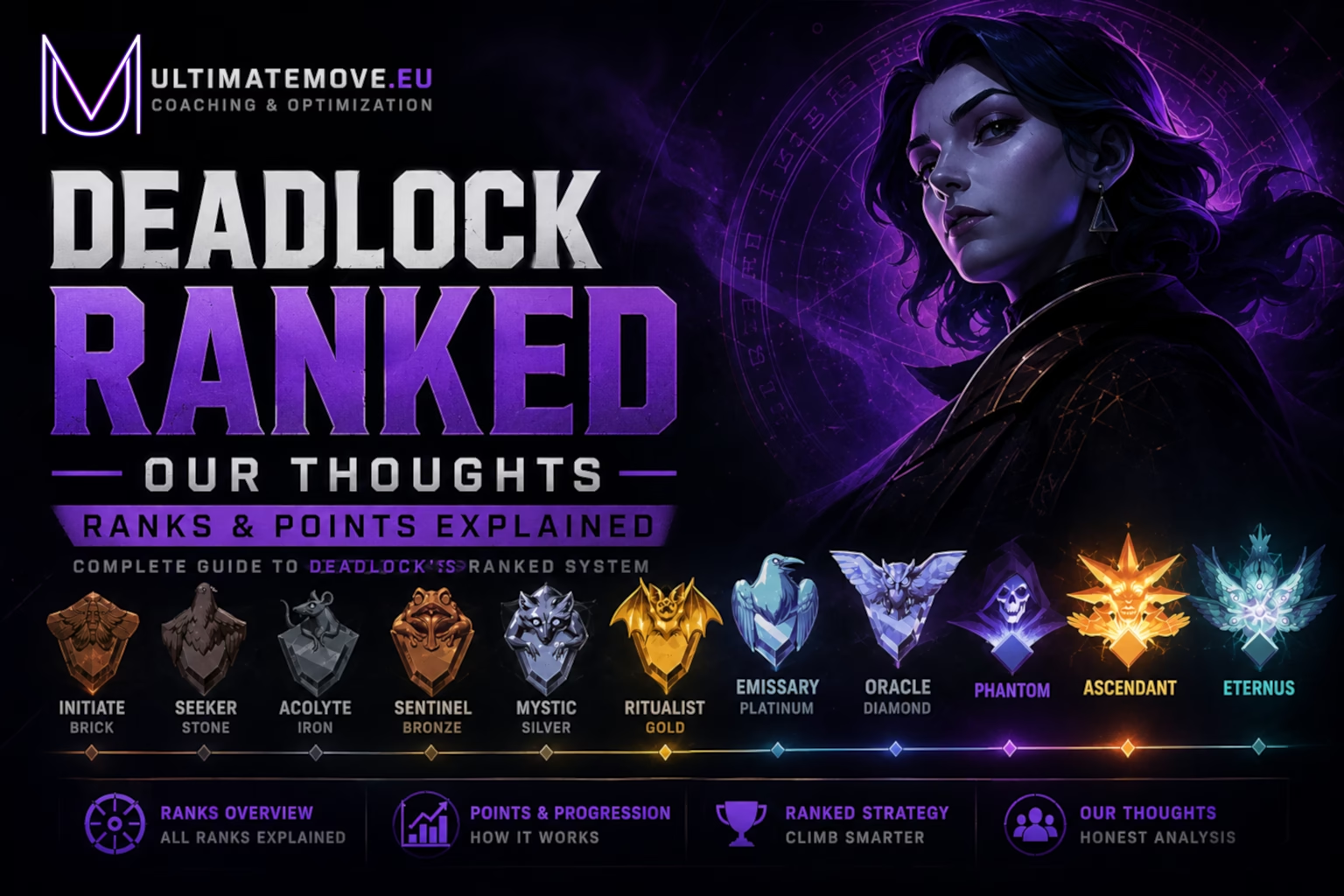
On 30 July 2026 Valve turned Deadlock matchmaking upside down. If you are coming back after a break, or you do not follow patch notes, you may feel like you launched a different game. This article explains the entire new ranked system from scratch, and at the end it says plainly what we think of it after winning and losing enough matches in it to have an opinion.
Two queues instead of one
Until now you simply joined a queue. There are two of them now, and they are completely different worlds.
Standard is the relaxed mode. No ranks, no party size limit, no skill restrictions. Queue with five friends and play. This is where you learn heroes and collect the wins you need for ranked.
Ranked is a seasonal queue with visible rank points, calibration and hard entry gates. The first season is called Beta Season 1 and ends on 7 October 2026. Your highest rank is saved permanently in your rank history, and after the season you receive a commemorative item for your hideout.
How to unlock ranked
The gates are the strictest Valve has ever put on this game, and you have to meet all of them at once:
- 60 wins in Standard mode
- at least three heroes eligible for ranked
- 15 wins with each of those heroes, because that is what makes them eligible
- no active matchmaking restrictions on your account
Then you play eight calibration matches, solo only. After that you get a starting rank, although calibration cannot place you higher than Oracle VI even if you win all eight.
In the queue itself you can party with at most one other player, and only with someone within one rank of you. In Eternus that narrows to three subranks. Ranked bans went up from two heroes to three.
We join your screen, save a restore point, then work down through BIOS, power, drivers and input. The same benchmark at the end shows how much of it landed. For six months after the session we stay with you on Discord.
Every rank in Deadlock
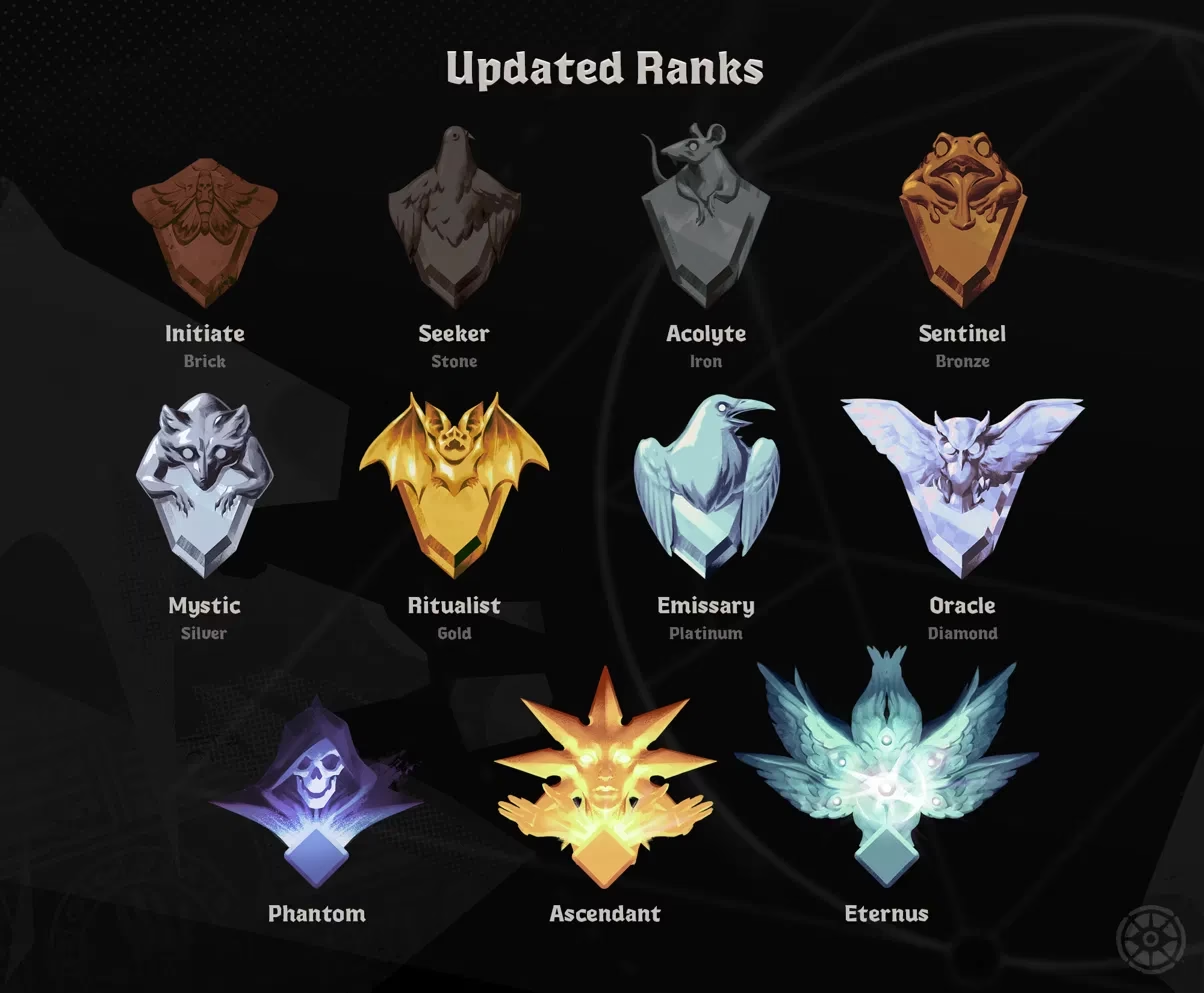
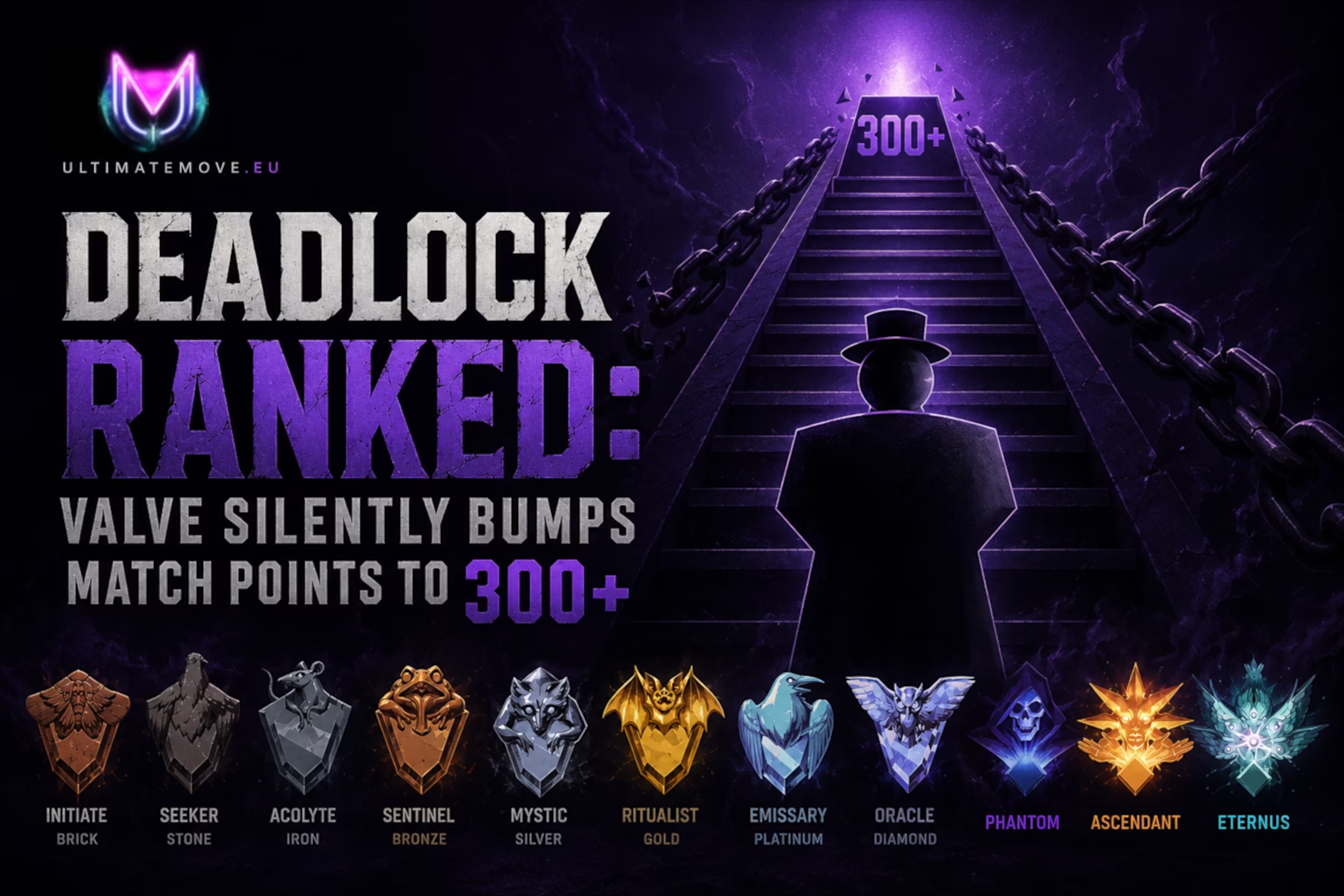
The icons and names were refreshed with this update. There are eleven ranks, each split into six subranks numbered I to VI. Some of them map onto classic naming, which makes it easier to place yourself if you are coming from another game.
- Initiate (Brick) - moth
- Seeker (Stone) - pigeon
- Acolyte (Iron) - rat
- Sentinel (Bronze) - frog
- Mystic (Silver) - fox
- Ritualist (Gold) - bat
- Emissary (Platinum) - raven
- Oracle (Diamond) - owl
- Phantom - Death in a Hood
- Ascendant - burning visage
- Eternus - winged being
Above Eternus I the thresholds stop being fixed and are recalculated daily on percentiles. Your subrank then depends on how many players are below you rather than on a round number of points.
How promotion is calculated
Every subrank costs 1000 points. Moving from the last subrank into the next full rank, for example Mystic VI to Ritualist I, costs 2000. A full rank is therefore five subranks at 1000 plus 2000 for the jump, which comes to 7000 points.
A specific number of points changes for each individual match. A note from July 30 mentions approximately 250, with a slight variation depending on the matchmaker’s expectations and the winning streak. In practice, since early August 2026, the values have been clearly variable, ranging from 300 to 480+?, though this change was not mentioned in any patch notes. We describe this separately in the article on rank points in Deadlock. The thresholds haven't changed, so count your progress over the course of ten games, not based on individual results.
Rank loss protection exists, but it works narrowly: only at zero points. At the bottom of a subrank you get two protected games, at the bottom of a full rank five. Outside those two spots there is none at all. Worth knowing, because a smaller loss does not mean the system spared you. If you see a lower amount than usual, it usually means you had fewer points left than the loss was worth and it was clipped at zero.
Leaving a match is handled sensibly. If someone leaves after the fifth minute, the match stops counting for their team unless that team wins anyway. A loss is then free and a win still scores normally.
Our opinion: It's impossible to tell what the system is paying for
Now for the part you're probably here for. In what Valve wrote about points, there's not a single word about your individual score. It only mentions the matchmaker's expectations and winning streaks.
We checked to see if this was due to a bonus for good play, and there’s no evidence to suggest that. In the matches we observed, fourth place with a lower rating yielded more points than second place with a higher rating. It’s more likely that this is simply a boost in jumps for a newly calibrated account - a mechanism familiar from any ranking system - but this remains a hypothesis, as there’s no clear pattern.
You can also see this from the other side. In a match with a score of 20/8/14, our Deadlock replay analyzer calculated a UM Score of 57 and a skill level corresponding to the Ascendant tier-which is significantly higher than the tier in which the match was played. It earned fewer points than the previous, clearly weaker victory.
I to jest sedno zarzutu. Nie chodzi o to, że system źle liczy, bo tego nikt z zewnątrz nie stwierdzi. Chodzi o to, że gracz nie ma jak odczytać własnego wyniku. Dostajesz liczbę, która raz wynosi 250 (obecnie minimalnie 300 za win 300 za lose), a raz 430, i nie wiesz, czy to nagroda, kara, korekta trudności, czy wygaszanie niepewności po kalibracji. System nieczytelny nie tworzy żadnej zachęty, nawet jeśli w środku jest sprawiedliwy. Najpewniej obecnie system bierze pod uwagę tylko winstreak - serię zwycięstw.
You can see the practical effect at the table. When a match starts to look like a loss, there’s no reason to keep trying, because there’s no individual reward left to earn in that match. That’s why people stop responding to calls and just head to the spawn - they’ll end up with the same negative score anyway. It’s not malice; it’s a lack of incentive.
Calibrating on Standard MMR is not calibration
In our view this is the biggest mistake in the whole update. Calibration rests on a rating carried over from a mode where you can play with five friends and no restrictions at all. Ranked inherited those ratings along with everything false in them, even though the calibration matches themselves are solo.
The effect is twofold, and one fuels the other. First, in ranked matches, players end up at ranks they haven’t earned on their own. We asked a lot of people about their previous rank, and most said they were around Phantom; then, during matches, they’re afraid to push the walker for fear of dying, so they just farm camps until the 40-minute mark.
Second, since the stake per match depends on the matchmaker’s expectations - which take into account the ratings of all twelve players - a Zboosted account on your team raises the forecast for the entire team. The system counts the match as a win, you lose the match, and you pay the full stake. A boosted account doesn’t just ruin the match - it raises the cost of defeat for everyone involved.
There is still no draft, and that is not an oversight
Bans went up from two heroes to three and the banning algorithm was improved. That is nice, but it is not a draft.
Valve has reversed the order: first you declare your hero preferences, and only then does the backend assemble the match to match players to those preferences and build a sensible composition. It sounds convenient and probably shortens the queue, but with this setup, the concept of a counter-pick ceases to exist. You choose your hero before the opponent has even been selected. It’s impossible to counter a team composition because, at the moment of selection, no team composition exists yet.
So if you feel like you’re running into better team compositions - and not just better players - it’s not paranoia. That’s how it was designed - it sucks, and they’re trying at all costs to delay it with propaganda claiming that the player community doesn’t get drafts XD or that everyone will want to play their own hero - but so what? All they need to do is implement a ban system or name the lanes and assign positions to them, just like in any other game with lane-based rules, such as LoL or DOTA…
What this update gets right
It would be unfair to stop at the complaints, because several decisions here are genuinely good and you can see in them the same hand that made the rest of the game.
The requirement to win 15 games with a specific champion takes care of the most annoying thing in any ranked match: someone who clicks on a champion for the first time in their life during a ranked match. The exclusive solo calibration means you can’t ride on a duo’s coattails. The party limit of two players and a one-rank difference puts an end to five-player groups preying on solo players. And the rule about leaving a match is the only place in the entire system where the incentive is exactly where it should be. Having to win 15 games takes a lot of time, and not everyone will like it - not everyone needs 15 games to get the hang of a given hero. For us personally, it’s a pain in the ass, despite our praise for the developers. Unlucky, I guess…
Four changes we would like to see
A full rank reset and real calibration inside ranked. Not a copy of Standard ratings. It would hurt for two weeks and settle the problem for the rest of the season.
A separate solo queue. A duo is better than a five stack, but it still gives a coordination edge a solo player does not have. If calibration is solo, the games should have that option too.
Draft Queue / the draft phase after a match has been submitted. Even if it's short, even if it's just a swap within the declared pool. That's enough to ensure the composition is no longer determined by chance.
Lepsze dopasowanie graczy umiejętnościami - powtarzające się stompy… Skoro matchmaker decyduje kto wygra w lobby często, nie ma sie co dziwić że nastaje toksyczna atmosfera między graczami. Niedość że bohaterowie są źle dobrani do teamów - to jeszcze gracze są gorsi w danej drużynie i nie chodzi nawet o znajomość bohatera tylko granie zespołowe - po prostu skill w grze.
How to play around it until something changes
Count in windows of ten matches, not one at a time. A single loss is a little over a quarter of a subrank, so it means nothing. A run of five means everything.
Keep a pool larger than the required minimum. Three heroes is an entry threshold, not a plan. Before the match you get 30 seconds to switch to another unlocked hero, so four or five heroes you actually know gives you a choice instead of an assignment.
Pick heroes using data from the ranked queue alone. The Deadlock API mixes both queues by default, and around 96 percent of matches come from Standard, where people try characters out casually. Our Deadlock tier list separates the two and shows the ranked meta and the Standard meta side by side. The differences are real, because several heroes near the top in Standard perform noticeably worse in ranked.
And if you want to see what specifically is costing you matches rather than just how many points they cost, that is exactly what we do. We run coaching w grach alongside match replay analysis.
Frequently asked questions
How do you unlock ranked in Deadlock?
You need 60 wins in Standard mode, three ranked-eligible heroes with 15 wins on each, and no active matchmaking restrictions. Then you play eight calibration matches solo.
How many ranks are there in Deadlock?
Eleven, from Initiate through Seeker, Acolyte, Sentinel, Mystic, Ritualist, Emissary, Oracle, Phantom and Ascendant, up to Eternus. Each one splits into six subranks.
How many points do you need for the next rank?
A subrank costs 1000 points and the jump into the next full rank costs 2000. A full rank comes to 7000 points in total.
Does playing well reduce your point loss?
Nic na to nie wskazuje. Valve wymienia wyłącznie oczekiwania matchmakera i passę zwycięstw, a obserwowane wartości nie układają się w żadną zależność od wyniku indywidualnego: czwarte miejsce z niższą oceną potrafi dać więcej punktów niż drugie z wyższą.
How does rank loss protection work?
Only at zero points. At the lower boundary of a subrank you get two protected games, at the lower boundary of a full rank five. In every other situation there is none.
Is there a counter picking in Deadlock?
No. You declare your heroes before submitting your match, so at the time of selection, your opponent's lineup doesn't exist yet.
What is the highest rank you can get from calibration?
Oracle VI. Even winning all eight calibration matches will not push you higher, the rest of the way has to be earned normally.
 KaRzye
Runs the research and every session at UltimateMove. FACEIT Level 10 in CS2,
Immortal in Valorant. Twenty years in BIOS, memory and drivers.
Watch him play.
KaRzye
Runs the research and every session at UltimateMove. FACEIT Level 10 in CS2,
Immortal in Valorant. Twenty years in BIOS, memory and drivers.
Watch him play.
Our free tools
Built in house. No account, no limits.
 Ultimate Demo Analyzer
Upload a CS2 demo and get your mistakes and round stats written out.
Free, no account Deadlock Replay Analyzer
The same for Deadlock: a replay breakdown and a plan for the next matches.
Free, no account Sensitivity Converter
Carry your cm/360 between games without losing muscle memory.
Free, no account Aim Trainer
Thirty seconds, three levels. No install, no account.
Free, no account